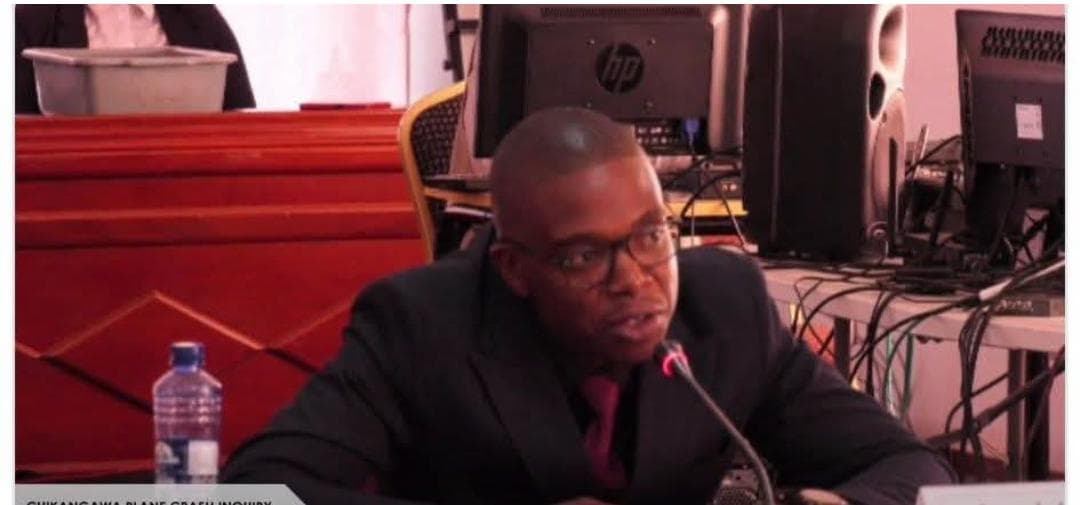
Captain Henry Nthani's appearance before Parliament's Ad Hoc Committee investigating the Chikangawa aircraft tragedy was one of the most eagerly anticipated moments of the inquiry.
As a highly experienced military aviator and former Operations and Training Officer in the Malawi Defence Force Air Wing, many expected his testimony to shed decisive light on the events that culminated in one of the country's most devastating aviation disasters.
To some extent, it did.
Nthani provided valuable insight into military aviation procedures, the capabilities of the Dornier aircraft involved in the crash, and the professionalism of the crew. He strongly defended both the aircraft and the pilots, describing the plane as reliable and the crew as highly trained and experienced.
Yet while his testimony answered some questions, it left the most important ones unresolved.
In many respects, it highlighted just how much remains unknown.
A key revelation was that Nthani was not directly involved in planning, authorising or executing the ill-fated mission because he was deployed in the Democratic Republic of Congo at the time. As a result, he lacked first-hand knowledge of many of the decisions that are now at the centre of public scrutiny.
Those are precisely the decisions Malawians desperately want answers to.
Who authorised the flight despite reports of poor weather conditions? What meteorological information was available before take-off? Were the risks properly assessed and documented? Were there alternative options considered? Did the presence of a high-profile passenger influence operational decisions? Who ultimately made the final call that the flight should proceed?
On these crucial questions, Nthani could provide little certainty.
His testimony also exposed another troubling reality: despite months of investigations and public debate, the exact cause of the crash remains elusive.
If the aircraft was mechanically sound and the pilots were highly competent, then what went wrong?
That is the question at the heart of this tragedy.
Nthani described the crash as a "mystery", a candid admission that underscores the limitations investigators continue to face. He offered possible explanations regarding the pilots' final actions and suggested they may have taken steps to minimise the risk of a post-impact fire. While such observations are important, they remain interpretations rather than definitive conclusions.
And therein lies the challenge.
Without a cockpit voice recorder or flight data recorder, investigators are deprived of the two most important tools used worldwide to reconstruct the final moments of an aircraft's journey. In their absence, conclusions inevitably rely on fragments of evidence, witness accounts, technical analysis and educated assumptions.
But assumptions, however informed, are not the same as proof.
Perhaps the most significant gap exposed by Nthani's testimony concerns operational accountability.
Aviation accidents are rarely caused by a single event. They are often the result of a chain of decisions, assessments, communications and actions. Understanding what happened inside that chain is essential if the nation is to learn lessons and prevent future tragedies.
The Committee therefore faces a challenge that goes beyond determining how the aircraft crashed. It must establish why decisions were made, who made them and whether established procedures were followed.
Several critical questions continue to linger.
Why did the aircraft reportedly descend to unusually low altitudes? Why did it appear to deviate from its submitted flight plan? What communications took place between the crew and ground personnel during the final stages of the flight? Were weather conditions significantly worse than anticipated? Were standard operating procedures fully complied with throughout the mission?
These are not minor details. They are potentially the keys to understanding what happened in the skies over Chikangawa.
Captain Nthani's testimony has undoubtedly added value to the inquiry. It has helped the public better understand the aircraft, the crew and the operational environment in which the flight occurred.
But it has also reinforced a sobering reality: the most important questions surrounding the tragedy remain unanswered.
Until the Committee thoroughly examines the chain of command, decision-making processes, risk assessments and operational judgments that preceded the flight, the mystery that Nthani himself acknowledged will continue to hang over the nation.
For the families who lost loved ones, for the institutions seeking accountability and for a country still searching for closure, understanding what happened is not enough.
Malawi must also understand why it happened.